
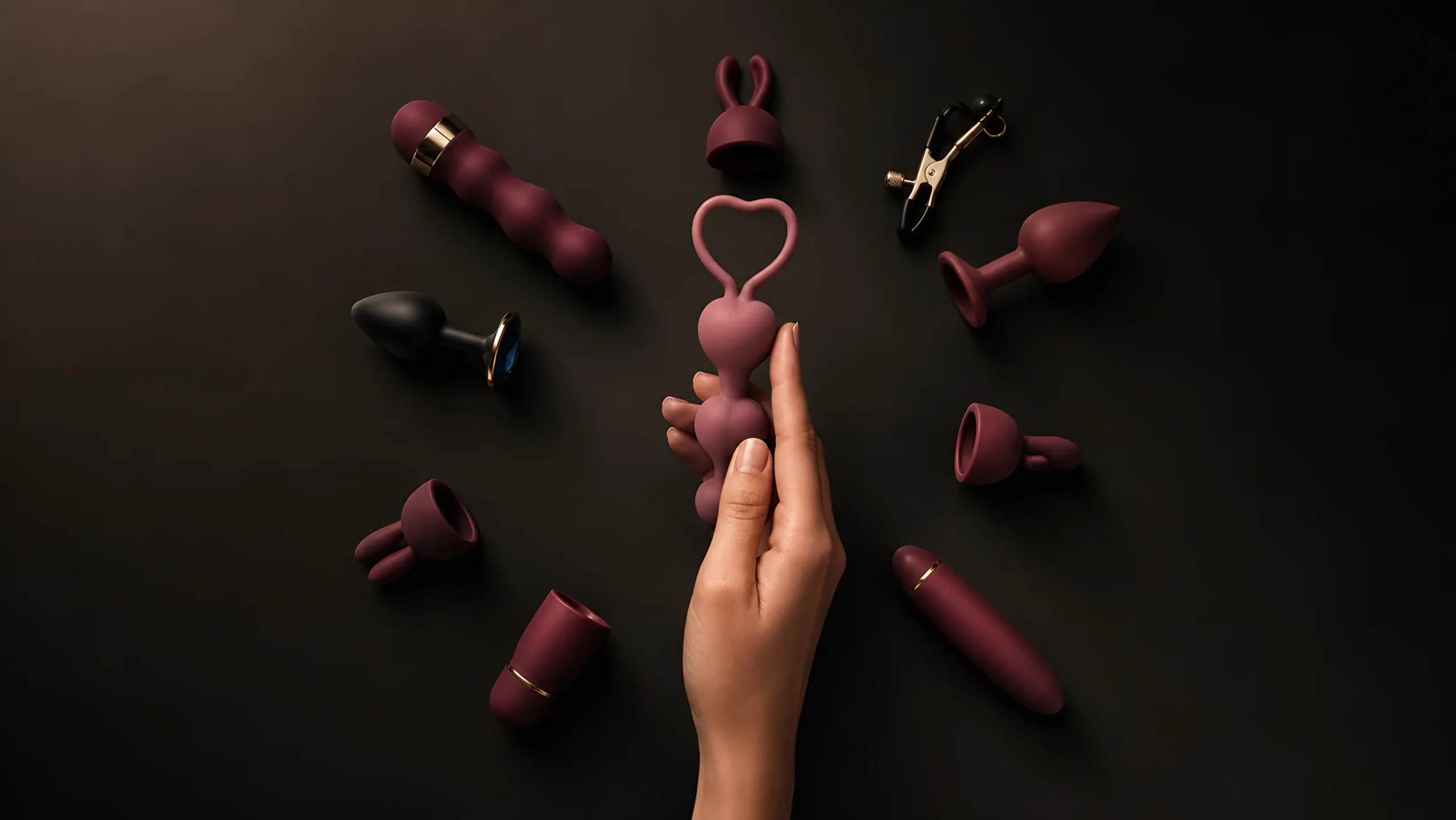
Quiet vibrators are not all equally quiet—and words such as “silent” or “whisper-quiet” rarely tell you enough to compare them.
A compact product can be surprisingly noticeable. A larger vibrator can have better internal insulation. A silicone covering may change how a device feels, but it does not prove that the motor produces less sound.
To judge a noise claim properly, look for evidence rather than assumptions:
- a decibel figure with clear testing conditions,
- manufacturer specifications,
- independent tests using a consistent method,
- detailed customer reviews, and
- realistic wording that does not promise complete silence.
The Quiet & Discreet collection can help narrow the search, but each product still needs to be assessed individually.
Quiet vibrators: what does “quiet” actually mean?
There is no universal retail definition of a quiet vibrator.
On one product page, “quiet” may mean the manufacturer has recorded a maximum sound level. On another, it may simply mean that someone on the marketing team considered the product less noticeable than another model.
That is why the word should be treated as a starting point rather than proof.
A useful noise claim should answer questions such as:
- What sound level was recorded?
- At what distance was it measured?
- Was the product held in the air or touching a surface?
- Which intensity setting was used?
- Was the figure an average or a maximum?
- Which frequency weighting was used?
- How much background noise was present?
- Was the same method used for every product being compared?
If none of those details are available, the claim may still be sincere, but it is difficult to compare objectively.
Why “silent vibrator” is not a useful promise
A motorised product creates movement, and movement normally creates some sound or vibration transfer.
What someone hears depends on more than the motor itself. It can change with:
- the intensity setting,
- the vibration pattern,
- the way the product is held,
- contact with furniture or another surface,
- the size and furnishings of the room,
- the distance from the listener, and
- the condition of the motor and battery.
A product may feel discreet on its lowest setting but become clearly audible at maximum intensity. It may sound muted when held but noticeably louder when placed on a hard bedside table.
For that reason, phrases such as “completely silent,” “nobody will hear” or “roommate-proof” should be treated cautiously.
How to read a decibel claim
A decibel figure is more useful than vague language, but only when it comes with context.
“dB” alone is not a complete reporting format. A useful claim should identify the frequency weighting used—such as A-weighted dBA—and whether the value represents an equivalent average, maximum or peak reading.
It should also identify what was measured. A sound-pressure reading taken at a particular position in a room is not the same quantity as a standardised sound-power result for the source. Figures produced using different quantities or methods should not be compared as though they were identical.
Manufacturer manuals sometimes publish a maximum noise specification. For example, a LELO ELISE 2 manual lists a maximum noise level below 50 dB, while the MIA 3 manual lists a maximum below 60 dB.
Those figures are useful pieces of product information. They do not automatically prove that one product will sound quieter in your room unless both were measured under the same conditions.
When comparing decibel claims, check whether the manufacturer explains:
- the measurement distance,
- the product setting,
- the room or testing environment,
- the measuring instrument,
- the background-noise level,
- the frequency weighting, and
- whether the figure represents maximum, peak or average sound.
Professional sound measurement distinguishes between average, maximum and peak metrics, as well as A-, C- and Z-weighted readings. The NIOSH Sound Level Meter guidance also stresses the importance of tested, calibrated measurement tools.
A number without the measurement method should not be treated as a controlled comparison.
Distance changes the result
The distance between the product and the sound meter can change the recorded figure significantly.
NIOSH notes that doubling the distance from a noise source can decrease the measured level by as much as 6 dB, provided the listener or meter is not moving closer to a secondary noise source. In an ordinary room, walls, furnishings, reflections and nearby surfaces can alter the result further.
That means a product measured from ten centimetres away cannot be compared fairly with one measured from one metre away.
When looking at product tests, check whether the same distance was used throughout.
Compact does not automatically mean quiet
Compact products are often easier to store and travel with. That does not prove that they produce less noise.
A small bullet vibrator may use a fast motor that creates a noticeable higher-pitched sound. A larger device may contain better internal mounting or a casing that reduces rattling and resonance.
Noise can be affected by:
- motor design,
- motor speed,
- internal mounting,
- casing thickness,
- loose internal components,
- the number of motors,
- the power setting, and
- the way vibration travels through the product body.
Choose compact products for compact storage. Choose a quiet product only when there is evidence supporting the noise claim.
Silicone does not automatically mean quieter
A soft silicone surface can change the feel of a product and may reduce some sharp contact sounds. It does not prove that the device itself is quiet.
The sound still depends on the motor, internal structure, casing and assembly.
The same applies to:
- ABS plastic,
- metallic finishes,
- soft-touch coatings, and
- premium-looking construction.
You cannot determine a motor’s noise level from the surface material alone.
Price does not prove low noise
A more expensive product may include better engineering, stronger quality control or more detailed specifications. It may also cost more because of branding, design, app functions or packaging.
Price alone cannot tell you:
- how loud the motor is,
- whether the sound is high- or low-pitched,
- how the product behaves at maximum intensity,
- whether it rattles against a surface, or
- whether the noise changes over time.
A noise recommendation should be based on the product’s evidence, not its price or appearance.
What changes the sound during use?
Intensity level
Higher intensity often produces more motor sound and stronger vibration transfer. Check whether a review or test refers to the lowest setting, maximum setting or the full range.
Vibration pattern
A steady vibration may produce a different sound from pulses, waves or rapid changes in speed. A product described as quiet in one mode may be more noticeable in another.
Surface contact
A running vibrator placed on a hard table can transfer vibration into the furniture, making the surface act as an additional sound source.
A product held freely, pressed against the body or placed on a soft surface can produce different results. Tests should explain which method was used.
Room acoustics
Bathrooms, tiled rooms and sparsely furnished spaces can make sounds more noticeable. Bedrooms with curtains, rugs, upholstered furniture and bedding may absorb more sound.
This is one reason customer experiences can differ even when they use the same product.
Battery condition
A low battery may change motor performance. Over time, wear, loosened components or charging faults may also alter the sound.
If a product becomes noticeably louder, starts rattling or produces an unfamiliar sound, stop using it and check the manufacturer’s troubleshooting and warranty instructions.
How to judge a product page
A useful page for a low-noise product should include several of the following:
- a measured noise level,
- the setting on which it was measured,
- measurement distance,
- the metric and frequency weighting used,
- whether the figure is average, maximum or peak,
- a downloadable manufacturer manual,
- verified reviews that discuss noise in detail,
- a video recorded without loud music covering the motor sound,
- separate comments about low and high settings, and
- realistic acknowledgement that the device is not completely silent.
Be cautious when the only evidence consists of phrases such as:
- whisper-quiet,
- virtually silent,
- completely discreet,
- impossible to hear,
- roommate-proof, or
- the quietest vibrator available.
Those descriptions may communicate an intention, but they do not provide a repeatable measurement.
How to use customer reviews
Customer reviews are subjective, but several detailed reviews can reveal useful patterns.
Look for descriptions such as:
- quiet on lower levels but louder at maximum,
- noticeable through a closed door,
- audible mainly when touching furniture,
- higher-pitched than another named product,
- quiet enough for one living arrangement but not another, or
- becoming louder after several months.
A review becomes more useful when the writer explains:
- which setting they used,
- how close another person was,
- whether the door was open or closed,
- whether the product touched a hard surface, and
- which previous product they are comparing it with.
Give more weight to repeated, specific observations than to a single review that says only “very quiet.”
Manufacturer evidence, independent tests and retailer tests
Manufacturer evidence
Manufacturer manuals can provide useful specifications, but check whether the test method is disclosed.
Independent testing
An independent comparison is most useful when every product is measured:
- in the same room,
- with the same sound meter,
- using the same metric and weighting,
- at the same distance,
- in the same position or orientation,
- on the same settings, and
- against the same background-noise level.
Retailer testing
A retailer can create meaningful noise comparisons by publishing a repeatable method rather than assigning informal labels.
A credible retailer test should record:
- the room and background-noise level,
- the sound meter or validated measurement tool,
- the metric and frequency weighting used,
- the distance from the product,
- the product’s position and orientation,
- whether the product was held or placed on a surface,
- the lowest setting,
- a middle setting,
- the maximum setting,
- steady and patterned modes where relevant, and
- notes about pitch, rattling and vibration transfer.
Professional equipment-noise standards such as ISO 3744 establish controlled methods for determining sound power from sound-pressure measurements. ISO 3744 is not a pleasure-product certification, but it illustrates why the environment, equipment and measurement method must be documented.
Without one consistent method, product rankings remain impressions rather than reliable comparisons.
Can you test a vibrator yourself?
A home test cannot recreate a laboratory measurement, but it can help you compare products you already own if you use the same method each time.
Keep the following consistent:
- the same room,
- the same phone or sound meter,
- the same measurement metric,
- the same distance,
- the same device orientation,
- the same surface,
- the same background conditions, and
- the same intensity settings.
The NIOSH Sound Level Meter app is available for iOS devices and has been tested and validated for workplace-noise measurement. NIOSH lists it as accurate within ±2 dBA, while Type 2 performance requires a calibrated external microphone.
The app was created for workplace-noise assessment rather than pleasure-product certification. A phone reading should therefore be treated as a personal comparison, not a universal product rating.
Non-motorised products
If motor noise is the deciding factor, a non-motorised product is the most predictable option.
Products without a motor include:
- dildos,
- glass products,
- stainless-steel products,
- anal plugs,
- some prostate toys, and
- sensory accessories.
These products do not generate motor noise, although movement, furniture and accessories can still produce ordinary sound.
You can compare non-motorised options under Dildos & Penetrative Toys or Anal Toys & Prostate Massagers.
Quiet and travel-friendly are different criteria
A travel-friendly product may be:
- compact,
- easy to store,
- rechargeable,
- equipped with a travel lock, or
- supplied with a pouch or case.
None of those features proves that the motor is quiet.
Likewise, a low-noise product may be too large for convenient travel or may lack a travel lock.
Use the Travel-Friendly collection for size and transport features, and evaluate the noise evidence separately.
Quiet vibrators for first-time buyers
For a first vibrator, noise is only one part of the decision.
Also check:
- whether the intensity starts low,
- whether it can be reduced without cycling through every mode,
- whether the controls are easy to identify,
- whether the dimensions suit the intended use,
- whether the product page explains charging and runtime, and
- whether opened intimate products can be returned if they are not faulty.
The Beginner-Friendly Sex Toys guide explains those selection criteria in greater detail.
Before buying a quiet vibrator
Ask:
- Is there a real noise measurement?
- Are the testing conditions disclosed?
- Is the figure measured at minimum or maximum intensity?
- Does the claim identify the metric and frequency weighting?
- Do detailed verified reviews support the claim?
- Does the product become noticeably louder in patterned modes?
- Are complaints about rattling or high-pitched sound repeated?
- Is a non-motorised product a better fit?
- Does the warranty cover motor or charging faults?
- Will opening the hygiene seal affect change-of-mind returns?
If noise is essential and the available evidence is vague, do not rely on the word “quiet” alone.
The practical conclusion
Do not assume that a vibrator is quiet because it is compact, silicone-covered, expensive or presented with elegant language.
The strongest evidence comes from:
- manufacturer specifications with test conditions,
- controlled comparisons,
- repeatable retailer testing, and
- several detailed customer reviews that describe the same behaviour.
When the evidence is limited, treat “quiet” as a relative claim rather than a guarantee.
When motor sound is the deciding concern, a non-motorised product remains the more predictable choice.
Quiet vibrators and discreet sex toys FAQs
Are bullet vibrators always quieter?
No. A bullet’s compact size makes it easier to store, but motor design, speed, internal construction and intensity determine how noticeable it sounds.
Does silicone make a vibrator quieter?
Not by itself. Silicone describes the outer surface. Motor design, casing, internal mounting and assembly have a greater influence on the device’s sound.
What decibel level counts as quiet?
There is no useful universal threshold without knowing the distance, setting, room, background noise, frequency weighting and measurement method.
Can customer reviews prove that a vibrator is quiet?
They cannot provide a controlled scientific measurement, but several detailed and consistent reviews can reveal useful real-world patterns.
Are non-motorised sex toys completely silent?
They do not create motor noise. Movement, furniture or accessories can still create ordinary sound during use.
Sources
- ISO 3744:2025 — Acoustics: Determination of Sound Power Levels of Noise Sources Using Sound Pressure
- NIOSH Sound Level Meter App: Features, Validation and Technical Specifications — CDC
- Use Administrative Controls: Distance and Noise Measurement — CDC/NIOSH
- ELISE 2 User Manual and Maximum Noise Specification — LELO
- MIA 3 User Manual and Maximum Noise Specification — LELO
Compare noise evidence—not vague promises.